
A Minecraft enchantments guide helps you understand how to improve your weapons, armor, tools, and other equipment using magical upgrades called enchantments. The best enchantments depend on your goals—whether you’re surviving your first night, defeating the Ender Dragon, building massive projects, or exploring dangerous caves. This guide explains every important mechanic, the best enchantments for each item, how enchanting actually works, and the smartest strategies for beginners and experienced players alike.
Before you start enchanting, learn how to find diamonds in Minecraft so you can collect the resources needed for powerful gear.
Introduction
Enchantments are one of the biggest power boosts in Minecraft. They can transform an ordinary diamond pickaxe into a nearly unbreakable mining machine, turn a simple bow into a devastating ranged weapon, or make your armor capable of surviving fights that would otherwise be impossible.
Despite looking simple, Minecraft’s enchanting system has surprising depth. Enchantment levels, compatibility rules, experience costs, bookshelves, anvils, villagers, and enchanted books all work together in ways that aren’t immediately obvious.
After playing Minecraft through dozens of survival worlds over the years—from early-game wooden tools to fully enchanted Netherite gear—the biggest lesson is this:
The strongest equipment isn’t created by luck. It’s built through planning.
Many players waste valuable experience levels by enchanting too early, combining books inefficiently, or choosing enchantments that don’t fit their playstyle. Learning how the system works saves hours of grinding later.
This guide covers everything from your very first enchantment table to creating perfect endgame gear.
Why This Matters
Enchantments don’t simply make numbers bigger—they fundamentally change how you play Minecraft.
Without enchantments:
- Mining takes longer.
- Weapons deal less damage.
- Armor breaks quickly.
- Exploring becomes riskier.
- Boss fights become much harder.
With the right enchantments:
- Diamond ore appears faster thanks to Fortune.
- Pickaxes mine almost instantly using Efficiency.
- Armor lasts dramatically longer with Unbreaking.
- Elytra flights become nearly unlimited with Mending.
- Combat becomes safer and more forgiving.
Think of enchantments as permanent upgrades rather than temporary buffs.
For example:
A normal Diamond Pickaxe may last several mining trips.
A Diamond Pickaxe with:
- Efficiency V
- Unbreaking III
- Fortune III
- Mending
can easily last for months of gameplay while collecting significantly more resources.
That’s why experienced players prioritize enchanting long before building giant bases.
What You Need to Know Before Starting
Before chasing powerful enchantments, understand the four systems that power Minecraft enchanting.
1. Experience Levels (XP)
Enchanting costs experience levels.
You earn XP from:
- Mining ores
- Killing mobs
- Smelting items
- Trading with villagers
- Fishing
- Breeding animals
- Completing certain activities
Remember:
Levels are not linear.
Going from Level 29 to 30 requires far more XP than going from Level 1 to 2.
Because of this, experienced players rarely waste Level 30 enchants on mediocre equipment.
2. Enchanting Table
The enchanting table is your primary source of enchantments early in the game.
You’ll need:
- 4 Obsidian
- 2 Diamonds
- 1 Book
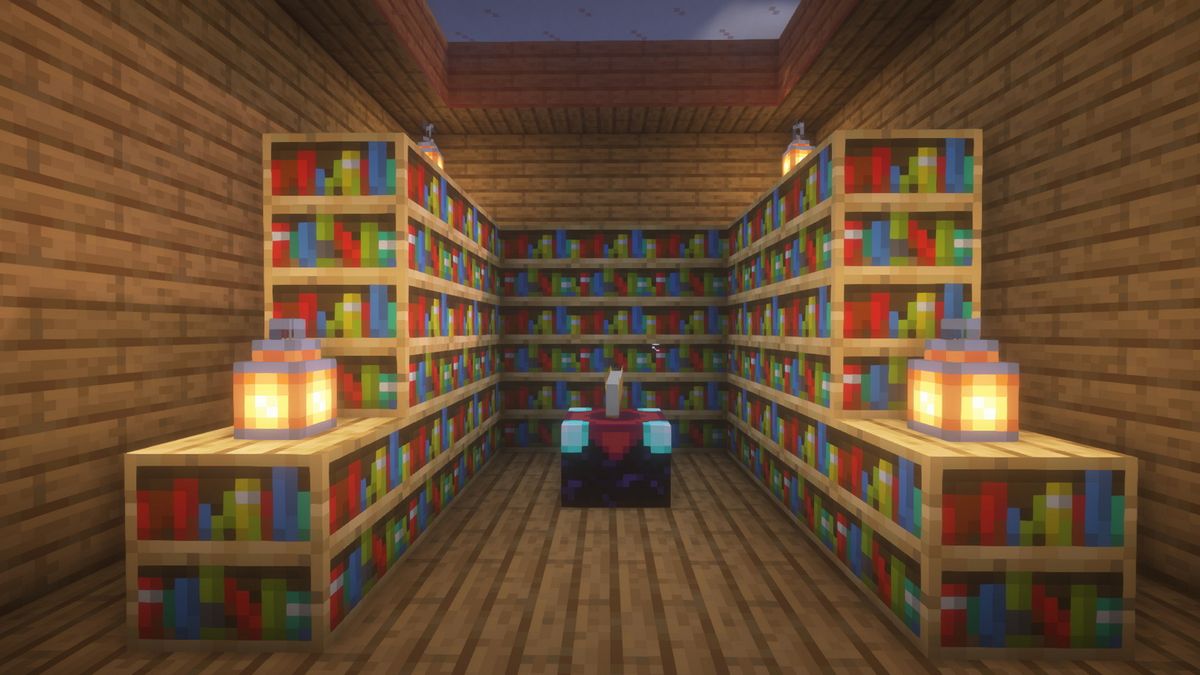
Once placed, surround it with bookshelves for stronger enchantments.
Maximum Setup
The highest enchantment level requires:
- 15 Bookshelves
- One block of air between shelves and table
Example layout:
BBBBB

B   B

B E B

B   B

BBBBB
Where:
- B = Bookshelf
- E = Enchanting Table
⚠ Warning
Many beginners accidentally place bookshelves directly against the enchanting table.
This does not work.
Always leave one empty block between the table and every bookshelf.
3. Lapis Lazuli
Enchanting also consumes Lapis Lazuli.
Each enchantment requires:
- XP Levels
- Lapis
Without Lapis, you cannot enchant items.
A good early strategy is mining deep underground before building your enchantment setup.
4. Anvils
The anvil is arguably more important than the enchanting table later in the game.
Anvils allow you to:
- Combine enchanted books
- Merge enchantments
- Repair equipment
- Rename gear
This is how players create perfect equipment with multiple enchantments.
Understanding Enchantment Levels
Enchantments have levels shown as Roman numerals.
For example:
| Level | Roman Numeral |
|---|---|
| 1 | I |
| 2 | II |
| 3 | III |
| 4 | IV |
| 5 | V |
Example:
Efficiency I
is much weaker than
Efficiency V.
Higher isn’t always available naturally.
Sometimes you’ll need to combine books using an anvil to reach maximum levels.
Types of Enchantments
Minecraft enchantments fall into several categories.
| Category | Examples |
|---|---|
| Weapon | Sharpness, Looting, Fire Aspect |
| Tool | Fortune, Silk Touch, Efficiency |
| Armor | Protection, Feather Falling |
| Bow | Power, Infinity |
| Crossbow | Multishot, Quick Charge |
| Trident | Loyalty, Channeling |
| Fishing | Luck of the Sea, Lure |
| Utility | Mending, Unbreaking |
Understanding these categories helps avoid incompatible combinations later.
How Enchanting Actually Works
Many players believe enchanting is completely random.
It isn’t.
Minecraft generates enchantment possibilities based on several factors:
- Item type
- Bookshelf count
- Enchantment weight
- Available enchantments
- Experience level
For example:
A shovel can never receive Sharpness directly.
A sword cannot receive Fortune.
Each item has its own enchantment pool.
The Three Enchantment Choices
Every time you place an item inside the enchanting table, you’ll see three options.
Each option costs:
- Different XP
- Different Lapis
- Produces different enchantments
Usually:
Level 30 enchantments provide the strongest combinations.
However, experienced players sometimes intentionally choose lower levels because they’re hunting one specific enchantment.
Rerolling Enchantments
Didn’t like the available options?
You don’t have to accept them.
Instead:
Enchant any cheap item.
Examples:
- Wooden shovel
- Wooden axe
- Book
Doing this refreshes the available enchantments.
This simple trick saves enormous amounts of XP.
⚠ Warning
Never repeatedly enchant expensive Diamond or Netherite gear hoping for better options.
Use cheap items to reroll instead.
You’ll save diamonds and experience.
Enchanted Books
Enchanted books are among the most valuable items in Minecraft.
Unlike direct enchanting, books can be stored indefinitely until needed.
Sources include:
- Villager trading
- Fishing
- Dungeon loot
- Ancient Cities
- Strongholds
- Mineshafts
- Bastions
The biggest advantage?
You decide exactly when to apply them.
This gives much more control than random enchanting.
The fastest way to obtain rare enchantments is through Minecraft villager trading guide strategies.
Villager Trading: The Secret to Perfect Gear
If there’s one strategy that separates casual players from experienced survival worlds, it’s this:
Use Librarian villagers.
A Librarian can eventually sell:
- Mending
- Efficiency V
- Silk Touch
- Fortune III
- Protection IV
- Sharpness V
Instead of relying entirely on luck.
Many long-term worlds eventually stop using the enchanting table for major upgrades because villagers provide far more consistency.
Pro Tip: Build a small trading hall early. It takes time to set up, but it pays off for the rest of your survival world.
Understanding Enchantment Compatibility
Not every enchantment works together.
Some combinations are intentionally blocked.
For example:
| Enchantment | Cannot Combine With |
|---|---|
| Fortune | Silk Touch |
| Infinity | Mending (Java Edition) |
| Sharpness | Smite, Bane of Arthropods |
| Protection | Blast, Fire, Projectile Protection (on most modern versions, general Protection remains mutually exclusive with the specialized protections on the same armor piece) |
Learning these rules prevents expensive mistakes when combining books.
In the next section, we’ll cover every major enchantment category, the best enchantments for each item, how to build perfect endgame gear, and the most efficient enchanting strategies from early game to late game.
Step-by-Step Guide
Whether you’re enchanting your first iron pickaxe or building perfect Netherite gear, following the right order saves time, experience, and valuable resources.
Step 1: Gather Essential Resources
Before you enchant anything, collect the following:
| Resource | Why You Need It |
|---|---|
| Diamonds | Craft an enchanting table and high-tier gear |
| Obsidian | Required for the enchanting table |
| Book | Craft the enchanting table |
| Lapis Lazuli | Used for every enchantment |
| Sugar Cane | Craft bookshelves |
| Leather | Make books |
| Iron | Craft anvils |
| Experience (XP) | Pays for enchanting and anvil work |
Create the perfect setup by following our guide on how to build an enchanting room with maximum bookshelf power.
Recommended Early Goal
Aim for:
- 30+ XP Levels
- 15 Bookshelves
- 1 Enchanting Table
- 1 Anvil
- A stack of Lapis Lazuli
This setup is enough to begin creating powerful gear.
Step 2: Build a Level 30 Enchanting Setup
Your enchanting table should be surrounded by 15 bookshelves with one air block between the shelves and the table.
Doing this unlocks Level 30 enchantments, which offer the strongest enchantment combinations.
Pro Tip: Carpet, torches, and most transparent blocks won’t block bookshelves, but solid blocks will.
Step 3: Decide Which Item to Enchant
Don’t enchant every item immediately.
Prioritize equipment that gives the biggest return.
Recommended order:
- Diamond Pickaxe
- Diamond Armor
- Sword
- Bow
- Axe
- Shovel
- Elytra
- Trident
- Fishing Rod
Mining faster usually leads to better equipment sooner.
Step 4: Use Enchanted Books
Instead of relying only on random enchantments:
- Trade with Librarians
- Explore structures
- Fish for enchanted books
Books allow you to build exactly the gear you want.
Step 5: Combine Enchantments Efficiently
Every anvil use increases an item’s “prior work penalty.”
To reduce future XP costs:
- Combine books together first.
- Then apply them to the item.
For example:
Instead of:
Book → Sword
Book → Sword
Book → Sword
Use:
Book + Book
↓
Combined Book + Book
↓
Final Book → Sword
This often saves dozens of experience levels.
Complete Enchantment Guide
Below are the most useful enchantments for every item type.
Sword Enchantments
Swords are your primary melee weapon throughout most of the game.
| Enchantment | Effect | Recommended |
|---|---|---|
| Sharpness V | More damage to all mobs | ★★★★★ |
| Looting III | More drops from mobs | ★★★★★ |
| Unbreaking III | Slower durability loss | ★★★★★ |
| Mending | Repairs using XP | ★★★★★ |
| Sweeping Edge III (Java) | Larger sweep attacks | ★★★★★ |
| Fire Aspect II | Burns enemies | ★★★★☆ |
| Knockback II | Pushes enemies away | ★★★☆☆ |
Best Sword Build
- Sharpness V
- Looting III
- Sweeping Edge III (Java Edition)
- Unbreaking III
- Mending
- Fire Aspect II
This combination handles almost every PvE situation efficiently.
Pickaxe Enchantments
The pickaxe is arguably the most valuable enchanted tool.
| Enchantment | Effect |
|---|---|
| Efficiency V | Mines blocks significantly faster |
| Fortune III | Increases ore drops |
| Silk Touch | Collects blocks intact |
| Unbreaking III | Longer durability |
| Mending | Automatic repairs |
Fortune vs Silk Touch
| Fortune III | Silk Touch |
|---|---|
| More diamonds | Collect diamond ore |
| More coal | Collect glass |
| More redstone | Collect ice |
| More lapis | Collect ores for later |
Which Is Better?
Use Fortune for gathering resources.
Use Silk Touch for building and transporting rare blocks.
Most experienced players eventually carry both.
Axe Enchantments
Axes are useful for both combat and wood gathering.
Recommended:
- Efficiency V
- Sharpness V (combat)
- Unbreaking III
- Mending
Shovel Enchantments
Best setup:
- Efficiency V
- Unbreaking III
- Mending
- Silk Touch (for grass and mycelium)
or
- Fortune III (for flint farming)
Hoe Enchantments
Often overlooked, hoes become valuable in late-game farming.
Best enchantments:
- Efficiency
- Fortune
- Silk Touch
- Unbreaking
- Mending
Fortune dramatically increases crop yields for many harvestable plants.
Armor Enchantments
Helmet
Recommended:
- Protection IV
- Respiration III
- Aqua Affinity
- Unbreaking III
- Mending
Optional:
- Thorns III
Before investing in Netherite upgrades, understand the full Minecraft armor progression guide to choose the right equipment path.
Chestplate
Recommended:
- Protection IV
- Unbreaking III
- Mending
Optional:
- Thorns III
Leggings
Recommended:
- Protection IV
- Unbreaking III
- Mending
Boots
Boots receive some of Minecraft’s strongest enchantments.
Recommended:
- Protection IV
- Feather Falling IV
- Depth Strider III
- Soul Speed III
- Unbreaking III
- Mending
Alternative:
Replace Depth Strider with Frost Walker II if your playstyle focuses on exploring oceans and frozen terrain.
Best Overall Armor Build
| Piece | Best Enchantments |
|---|---|
| Helmet | Protection IV, Respiration III, Aqua Affinity, Unbreaking III, Mending |
| Chestplate | Protection IV, Unbreaking III, Mending |
| Leggings | Protection IV, Unbreaking III, Mending |
| Boots | Protection IV, Feather Falling IV, Depth Strider III, Soul Speed III, Unbreaking III, Mending |
This setup offers excellent protection for almost every activity in Survival Mode.
Bow Enchantments
The bow remains one of the safest weapons in Minecraft.
Recommended:
- Power V
- Unbreaking III
- Flame
- Punch II
- Infinity or Mending (depending on your edition and preference)
Infinity or Mending?
Infinity
Advantages:
- Only one arrow needed
- Great for long adventures
Mending
Advantages:
- Infinite durability with XP
- Excellent for long-term worlds
If you have easy access to arrows through farms or trading, Mending is often the better long-term investment.
Crossbow Enchantments
Crossbows are slower than bows but have unique strengths.
Recommended:
- Quick Charge III
- Multishot
or
- Quick Charge III
- Piercing IV
Also add:
- Unbreaking III
- Mending
Trident Enchantments
The trident is one of Minecraft’s most versatile weapons.
| Enchantment | Effect |
|---|---|
| Loyalty III | Returns after throwing |
| Channeling | Summons lightning during storms |
| Riptide III | Launches the player through water or rain |
| Impaling V | Extra damage to aquatic mobs (and more broadly in Bedrock Edition) |
| Unbreaking III | Better durability |
| Mending | Automatic repairs |
Important Compatibility
You cannot combine:
- Loyalty
- Channeling
with
- Riptide
Choose the version that best matches your preferred playstyle.
Fishing Rod Enchantments
Fishing becomes much more rewarding with enchantments.
Best setup:
- Luck of the Sea III
- Lure III
- Unbreaking III
- Mending
Luck of the Sea increases the chance of treasure items, while Lure speeds up bites, making fishing far more efficient.
Elytra Enchantments
The Elytra is one of the most valuable items in the game.
Always apply:
- Unbreaking III
- Mending
With these enchantments and a supply of fireworks, your Elytra can remain usable for an incredibly long time.
Flying becomes much safer when you master Elytra flight and firework guide techniques.
⚠ Warning
Never place expensive enchantments on temporary gear.
It’s usually better to wait until you have Diamond or Netherite equipment before using rare books like Mending, Protection IV, or Sharpness V. Saving these enchantments for your final gear prevents costly upgrades later.
Beginner Tips
If you’re new to Minecraft, enchanting can seem random and expensive. These tips will help you build strong gear without wasting resources.
1. Wait Before Enchanting Diamond Gear
It can be tempting to enchant the first diamond tools you craft, but patience pays off.
If you only have a few diamonds, focus on making essential tools first. Save rare enchanted books like Mending or Fortune III for gear you’ll keep for a long time.
Example:
Instead of enchanting three different diamond pickaxes, invest in one high-quality pickaxe with:
- Efficiency V
- Fortune III
- Unbreaking III
- Mending
It will last much longer and gather significantly more resources.
2. Mine Plenty of Lapis Lazuli
Many players remember to collect diamonds but forget about lapis.
Without lapis, even a Level 30 enchantment setup is useless.
A full mining trip should always include:
- Coal
- Iron
- Redstone
- Lapis
- Diamonds
3. Don’t Ignore Villagers
One of the biggest beginner mistakes is relying only on the enchanting table.
A single Librarian can eventually provide some of the best enchantments in the game, including:
- Mending
- Efficiency V
- Protection IV
- Fortune III
- Silk Touch
- Sharpness V
Villager trading removes much of the randomness from enchanting.
4. Keep Extra Enchanted Books
Don’t immediately apply every enchanted book you find.
Store useful books until you know which items you’ll keep long-term.
A simple chest labeled Enchantments can save hours of searching later.
5. Repair with Mending, Not the Anvil
Once your equipment has Mending, repairing it with an anvil usually isn’t necessary.
Instead:
- Mine ores
- Defeat mobs
- Trade with villagers
- Breed animals
The experience you earn will repair your gear automatically.
Maintaining enchanted equipment requires experience, so check out these best Minecraft XP farms for efficient leveling.
Advanced Tips
Experienced Minecraft players often spend less time grinding because they optimize their enchanting strategy.
Automated resources make survival easier, especially when using these best Minecraft farms for survival.
1. Build a Librarian Trading Hall
A trading hall may take time to create, but it’s one of the best long-term investments.
Benefits include:
- Guaranteed access to powerful enchantments
- Easy replacement books
- Reliable emerald income through trading
Many veteran players stop depending on random enchanting almost entirely.
Pro Tip: Lock in a desirable trade by purchasing from a Librarian before changing their workstation. This preserves the trade even if you later break and replace the lectern.
Surviving the Nether becomes much easier when you understand the dangers covered in our complete Nether survival guide.
2. Create Dedicated Tools
Rather than using one tool for everything, specialize.
Examples:
Mining Pickaxe
- Efficiency V
- Fortune III
- Unbreaking III
- Mending
Resource Collection Pickaxe
- Efficiency V
- Silk Touch
- Unbreaking III
- Mending
Switching between them gives you the flexibility to maximize resource collection or preserve special blocks.
3. Understand the Prior Work Penalty
Every time an item is used in an anvil, its future repair and combination costs increase.
To reduce XP costs:
- Combine books together first.
- Apply the finished book to the item.
- Avoid repairing the same item repeatedly with fresh materials.
Planning ahead keeps your endgame gear affordable to maintain.
4. Build an XP Farm
Powerful enchantments require a steady supply of experience.
Popular XP sources include:
- Mob grinders
- Enderman farms
- Guardian farms
- Gold farms
- Villager trading
- Smelting systems
- Animal breeding
Even a simple mob farm can provide enough XP to keep enchanted gear repaired with Mending.
5. Carry Backup Gear
Even experienced players can lose equipment in lava or the Void.
Keeping spare enchanted gear at your base means you can recover from accidents without starting from scratch.
Common Mistakes
Avoiding these mistakes will save hours of frustration.
Mistake 1: Enchanting Iron Equipment Too Much
Iron gear is excellent early on, but expensive enchantments are usually better saved for Diamond or Netherite equipment.
Mistake 2: Ignoring Unbreaking
Many players chase damage or speed first.
However, Unbreaking III often provides more long-term value by dramatically extending an item’s lifespan.
Mistake 3: Using Fortune on Everything
Fortune is excellent for ores but isn’t always the best choice.
Some building projects require collecting blocks intact, making Silk Touch the better option.
Mistake 4: Forgetting Compatibility Rules
Some enchantments simply can’t coexist.
Examples:
| Enchantment | Incompatible With |
|---|---|
| Fortune | Silk Touch |
| Sharpness | Smite, Bane of Arthropods |
| Infinity | Mending (Java Edition) |
| Loyalty | Riptide |
Always check compatibility before combining expensive books.
Mistake 5: Spending Levels Inefficiently
Reaching Level 30 takes much longer than reaching Level 10.
Avoid wasting high-level enchantments on temporary tools or armor.
⚠ Warning
Before using an anvil, double-check the XP cost.
If the game displays “Too Expensive!”, the combination can’t be completed in Survival Mode. Efficient planning and combining books in the right order helps prevent this issue.
Best Settings, Strategies, and Builds
Best Survival Armor Build
| Armor Piece | Recommended Enchantments |
|---|---|
| Helmet | Protection IV, Respiration III, Aqua Affinity, Unbreaking III, Mending |
| Chestplate | Protection IV, Unbreaking III, Mending |
| Leggings | Protection IV, Unbreaking III, Mending |
| Boots | Protection IV, Feather Falling IV, Depth Strider III, Soul Speed III, Unbreaking III, Mending |
This build offers excellent protection while improving underwater exploration and movement.
Once your gear is fully enchanted, prepare for the final challenge with our guide on how to defeat the Ender Dragon.
Best Mining Build
| Item | Enchantments |
|---|---|
| Pickaxe | Efficiency V, Fortune III, Unbreaking III, Mending |
| Backup Pickaxe | Efficiency V, Silk Touch, Unbreaking III, Mending |
| Helmet | Respiration III, Aqua Affinity |
| Boots | Feather Falling IV |
Ideal for long mining sessions and collecting valuable resources.
Best Combat Build
Sword
- Sharpness V
- Looting III
- Fire Aspect II
- Unbreaking III
- Mending
- Sweeping Edge III (Java)
Bow
- Power V
- Flame
- Punch II
- Unbreaking III
- Infinity or Mending
Armor
Full Protection IV set with Unbreaking III and Mending.
This setup handles nearly every PvE challenge, including raids, Nether exploration, and boss fights.
Best Exploration Build
Perfect for exploring the Overworld, Nether, and End.
Recommended equipment:
- Elytra with Unbreaking III and Mending
- Firework Rockets
- Feather Falling IV Boots
- Silk Touch Pickaxe
- Fortune Pickaxe
- Bow or Crossbow
- Shield
- Water Bucket (Overworld)
You’ll be prepared for caves, mountains, structures, and unexpected encounters.
Exploring dangerous locations requires preparation, so learn more with our Minecraft Ancient City guide.
Best Enchantments by Playstyle
| Playstyle | Priority Enchantments |
|---|---|
| Builder | Silk Touch, Efficiency, Unbreaking |
| Miner | Fortune, Efficiency, Mending |
| Explorer | Feather Falling, Mending, Unbreaking |
| Fighter | Sharpness, Protection, Looting |
| Farmer | Fortune, Efficiency, Mending |
| Fisher | Luck of the Sea, Lure |
Choosing enchantments based on your favorite activities is often more effective than trying to maximize every item at once.
Pro Tips from Long-Term Survival Worlds
- Build your enchanting room close to your storage system to reduce travel time.
- Carry both a Fortune and a Silk Touch pickaxe once you can afford it.
- Keep at least one spare set of enchanted armor before entering the End.
- Rename valuable tools on an anvil to help identify them quickly.
- Store enchanted books in organized chests or barrels by category.
- Use villagers to replace lost books instead of relying on random enchanting.
- Don’t rush Netherite upgrades—fully enchanting Diamond gear first is often more efficient.
Frequently Asked Questions
What is the best enchantment in Minecraft?
If only one enchantment could be chosen, Mending is arguably the most valuable.
Instead of increasing damage or protection directly, Mending repairs your equipment using experience orbs. Combined with Unbreaking III, it allows tools, armor, and weapons to last for an extremely long time.
For most long-term Survival worlds, Mending should be a top priority.
What is the maximum enchantment level?
Most enchantments have a maximum level between I and V.
Some examples:
| Enchantment | Maximum Level |
|---|---|
| Sharpness | V |
| Efficiency | V |
| Fortune | III |
| Looting | III |
| Protection | IV |
| Feather Falling | IV |
| Power | V |
| Respiration | III |
| Unbreaking | III |
Higher levels may exist through commands or custom maps, but they are not obtainable in standard Survival gameplay.
Which is better: Fortune or Silk Touch?
Neither is universally better—they serve different purposes.
Choose Fortune when you want to:
- Collect more diamonds
- Gather extra coal
- Increase redstone drops
- Farm lapis lazuli efficiently
Choose Silk Touch when you want to:
- Move valuable blocks
- Collect glass without breaking it
- Preserve ore blocks for later
- Gather ice, coral, or other delicate blocks
Many experienced players keep both pickaxes and switch depending on the task.
Can you remove enchantments?
Yes.
Using a Grindstone removes most enchantments from an item and returns a small amount of experience.
Keep in mind:
- Curse enchantments are not removed.
- Removed enchantments cannot be recovered.
- Enchanted books cannot be cleaned with a grindstone.
Can every enchantment be combined?
No.
Some enchantments are intentionally incompatible.
Common examples include:
- Fortune and Silk Touch
- Sharpness, Smite, and Bane of Arthropods
- Loyalty and Riptide
- Infinity and Mending (Java Edition)
Always check compatibility before spending valuable experience.
Is Netherite worth enchanting?
Absolutely.
Netherite equipment offers:
- Higher durability
- Better knockback resistance
- Improved overall performance
Since Netherite gear is expensive to obtain, it’s worth applying your strongest enchantments once you’ve upgraded from Diamond.
Should I enchant books or equipment first?
If you’re building endgame gear, enchanting books first usually provides more flexibility.
Books can be stored, traded, combined, and applied when needed, reducing the risk of wasting rare enchantments.
How do I get Mending?
The most reliable methods include:
- Trading with Librarian villagers
- Finding enchanted books in loot chests
- Fishing (rare)
- Exploring Ancient Cities and other structures
Villager trading is generally considered the fastest and most consistent method.
Does enchanting cost more over time?
Yes.
Every time you use an anvil on an item, its internal “prior work” cost increases. Eventually, repairs or combinations can become too expensive to perform in Survival Mode.
Planning your enchantments and combining books efficiently helps avoid this problem.
Which enchantments are best for beginners?
If you’re just starting, focus on these first:
- Efficiency
- Unbreaking
- Protection
- Sharpness
- Fortune
- Mending
These provide the biggest improvements to everyday gameplay.
Final Verdict
Minecraft’s enchanting system rewards planning more than luck. While the enchanting table is a useful starting point, the strongest equipment is usually the result of smart preparation—collecting experience, trading with Librarians, combining enchanted books efficiently, and choosing enchantments that suit your goals.
For beginners, prioritize Efficiency, Protection, Sharpness, and Unbreaking to make survival easier. As you progress, aim to add Mending to your favorite gear and build specialized tools, such as separate Fortune and Silk Touch pickaxes.
The most successful Survival players don’t simply chase the highest enchantment levels—they build a complete toolkit tailored to mining, combat, exploration, farming, and building. With a well-planned enchanting setup and the right strategy, you’ll spend less time replacing equipment and more time exploring, creating, and taking on Minecraft’s biggest challenges.